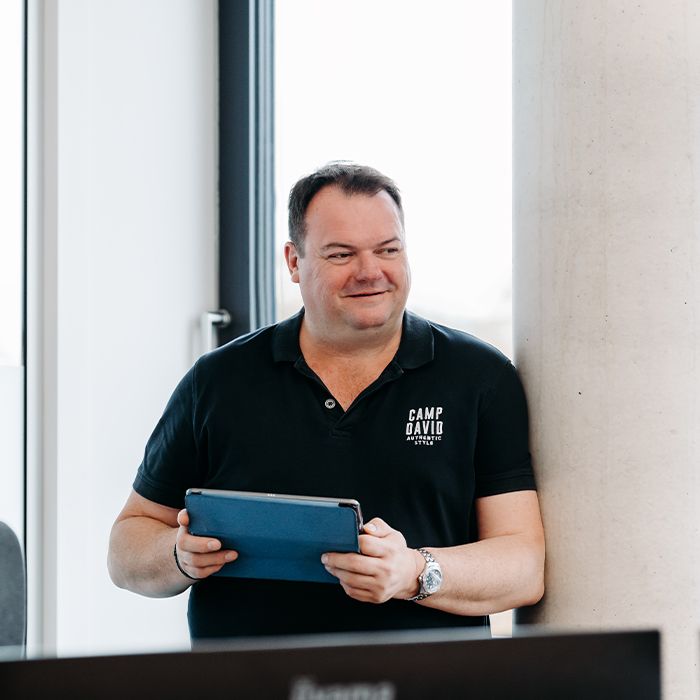


Interview with Steven Terry
XFAIR has been developing its own software solutions for years - web-based as well as mobile in the form of XFAIR apps. These solutions are tailored to the needs of our customers for each individual event. Steven Terry, Head of the Development Department, knows the challenges that come with these customisations.
Mr Terry, you and your team are essential to XFAIR when it comes to meeting the diverse requirements of our customers. How wide is the range of changes you make for different types of events?
There are many types of changes we make for different customers for the same or different events. This can be something as simple as styling the website in the customer’s CI (corporate identity) - for example, changing it from blue to red - or it can be as extensive as writing entirely new software. Last year, for instance, we had to develop a completely new voting system for one customer that was used for a single event only. Sometimes the scope sits somewhere in the middle, for example when we develop a new module - whether for the Admin Tool, registration, or one of the mobile apps. It may even be that we extend one of the existing modules to add new functionality. It all depends on what the customers need for the respective event.
Of course, you have to strike a balance between what the customer wants and what we can deliver for them. As I said, some things can be done in 15 minutes - for example, styling - and we would generally do that without any additional administration of the system. Larger requirements that lead to major changes in the software require more detailed specifications and documentation, as well as approval procedures. Not only on the customer’s side in terms of payment, since such changes naturally affect the cost of our services, but also on our side: whether this new development will be useful for other customers or only for this one customer. I have to maintain that balance and discuss with the different parties how much effort is involved and whether we can handle it with our current resources. Of course, at XFAIR we have a roadmap that shows where we want to take our development each year, and we have to fit all customer requirements into it.

Where do you focus most: maintaining and developing existing programmes, or developing new solutions and expanding the portfolio? How do you keep up with the latest IT security requirements?
Well, to answer the first part of the question: as I mentioned before, it’s about keeping the right balance. We have a roadmap of what we want to achieve this year. Naturally, it includes time for customer requirements and for improving the software in line with individual customer needs, but in general we want to expand our portfolio.
Whether that means a new solution in the sense of a new application, or updating a specific application to make it more user-friendly or to improve its look and feel; whether it’s about equipping individual modules with more features, or introducing a completely new module within an application. This balance between developing new and better solutions for our customers is, of course, offset by customer requirements and individual challenges. We have many customers with many different events, so at times it can be quite a challenge. However, it is part of my role to find the right balance between how much we want to do in terms of customer-specific enhancements and, at the same time, keeping an eye on the roadmap for new developments I mentioned earlier.
It goes without saying that meeting the latest IT security requirements is an important topic, especially in view of our current ISO certification. IT security is a key part of ISO certification within the development team. Yes, it is certainly challenging to keep up with the latest standards, but we are firmly committed to meeting that challenge.

How many people are currently working on the mobile applications and the web-based solutions? What are the biggest challenges of working in such an international team, and do you see code as your common language?
That’s a really interesting question, because I had to think about it. For a mobile application, you don’t just need a mobile app developer. Mobile applications - at least the ones we have - interact with a database. For that, web services need to be developed that sit between the application and the database. Those web services are written by a web developer. So, if we need to develop a new module for one of our apps, we don’t only need a mobile app developer, but also an EMS developer (that’s what our software is called) or a C# developer, because that’s the language in which the code for the web backend is written. That’s why it’s very difficult to say: “What is your mobile development team and what is your web application development team?”
In our team, we have an iOS developer who develops only for iOS and is therefore responsible only for iOS. Our Android developer has a web background and is therefore able to develop both the Android app and the web services. So they can do both, whereas our iOS developer cannot. But I and two other web developers in our team can write web services. So if you say, “Oh, we have a new requirement for the mobile app”, it doesn’t just take one or two people - the iOS and Android developers - but potentially also a web developer as part of the project. We are all one team, providing a core capability: creating event software for our customers. This team consists of seven people: myself, four senior developers, one junior developer and a software tester. Of those four senior developers, we have one for Android, one for iOS and two for C# development, which I also work on.
The biggest challenge for me has nothing to do with the team members. It’s about aligning customer requirements with the company’s roadmap, as I mentioned earlier. The concept of an international team is also interesting, but the common language is not code - it’s something different, because there are many programming languages. For example, I wouldn’t be able to fully understand the iOS code because I’m not an iOS developer. I could certainly read parts of it, but of course not all of it. The codebase as a whole - whether iOS or Android (Java or Kotlin), our web services (C#) or the database (SQL) - consists of different languages. All of these languages are written in English.
The challenge for me is ensuring that the code meets a certain standard and is readable and understandable for another developer, which means it must be properly commented. That’s why it’s part of our internal processes and development standards that all comments within the code are written in English, because all developers speak English, regardless of where they come from. For this reason, developers generally need to be able to speak English. It’s not because code is a single language - there are many different types of code and many different languages in the codebase, and someone who knows one language does not necessarily know another. It’s the same with spoken languages. The common denominator is that when you write code, you write it in English.
Managing an international team is not really an issue. Of course, there will be conflicts between different people, but those conflicts can also exist between people of the same nationality. It’s more that English is the common language - that’s how we work and develop.
Are you interested in becoming part of the XFAIR development team and helping shape innovative and flexible solutions for our customers? Then don’t hesitate to contact us via our application form - we look forward to hearing from you!